'/%3E%3C/svg%3E)


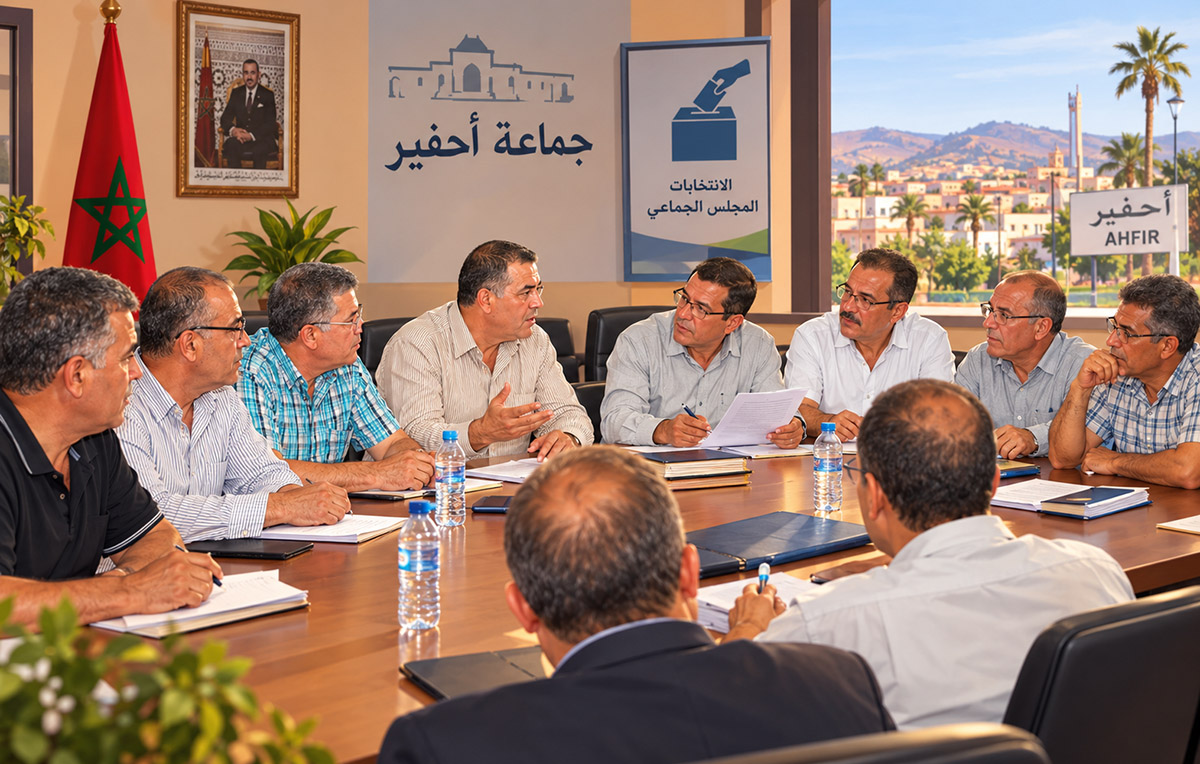
Abdelmajid Kassimi was the biggest “absent” in the group of 25 on paper, yet in reality he was the most present of all. He alone held not only the key to the municipality, but also the key to the rural council.
At eight o’clock in the evening on election day, I thanked God that everything had gone smoothly in the ballot box I was guarding. But I was in shock, like a drunk man: I mistakenly believed I had “buried” the president of the rose party, since he had lost in my box by 18 votes. I saw people congratulating Bentafrit, and dizziness struck me. I learned that he had won in the second box by 24 votes, giving him a final victory margin of 6.
My confusion grew when Jouber’s procession passed by: I understood that “the genie” had struck and that Ould Essafia had fallen.
News began pouring into my ears. I didn’t know whether I was happy, sad, or indifferent. I went to a small room to burn the ballots. I started burning the first one to place the others on top, but God made me notice that I was burning the invalid ballots. I extinguished the fire — only a quarter of a sheet was damaged. I was close to a disaster that even the judge of Fez couldn’t have saved me from. I went to the Pachalik with my report, trembling, cursing my greed for the 400 dirhams of the administration.
Despite my distress, the pasha and his deputy treated us with great courtesy and respect, despite the millions of ballots and thousands of mistakes we had brought them (mistakes like placing the pasha’s ballots in the court file, or the court’s ballots in the governor’s file… etc.).
I corrected all my errors and finished only at 1:15 a.m. I went to Kassimi’s headquarters: there was music, dancing, and celebration led by Jouber’s supporters. Delegations of all the elected officials from all parties were arriving to “console” Ould Essafia. That’s when I understood that Ould Essafia was not defeated: they weren’t coming to console him, but to seek his favor, because they had learned he had won 6 seats, placing him first.
What they didn’t know was that Abdelmajid — before crying (and I don’t believe he didn’t cry), before blaming his mother for giving birth to him after Jouber, and perhaps even before drinking a glass of water — had called Jouber to ask him to appoint him as his agent. And all signs indicate that Jouber accepted immediately.
The next morning, I met Bilal’s brother, elected in Ghazala rural. I told him Bilal would support Jouber. He replied: “You are very, very wrong. Bilal swore he would never join Jouber, even if he gave him everything.” I told him: “There are two things one should never swear about: cards and politics.” I’m not saying Bilal lies, but advise him not to swear again.
It is clear that Ould Essafia will be the one to appoint (if things go as expected) Jouber as president of the municipality.
Yesterday, I wrote a breaking news piece about Abidine’s “revolt”, accusing his leader Bechrouri of selling two councillors to Jouber. Notice that Abidine speaks only of two “pigeons”, while Jouber took three. I personally do not deny Abidine’s claim: Bechrouri likely played a role. Why? Because Bechrouri’s situation in the rural council is extremely difficult. One of his solutions is to convince Ould Essafia to transfer Ghazala rural from Dahmani’s camp to his own. And since politics works on “give me, I give you”, Bechrouri offered two councillors to Ould Essafia, Jouber’s secretary.
But Bechrouri forgot something very important: Ould Essafia is not ungrateful, contrary to what many think. He will not forget that Dahmani stood by him during the campaign. I had already written four times that during the campaign, all party discipline collapsed — and this was true for many parties.
While Abidine was cursing politics and accusing the RNI leader of selling two councillors, at that exact moment Merzougui, Amhamed, and other PAM candidates were searching for Badiâa, the third councillor who had fled to Jouber. PAM supporters did everything to prevent Merzougui and his companions from meeting her: they carried stones and sticks. Had they met, things would have ended badly — and indeed there were fights and injuries even without a meeting.
I have written before: many people welcome radical change, even if it comes “at any cost”.
By Jaloul (2012)