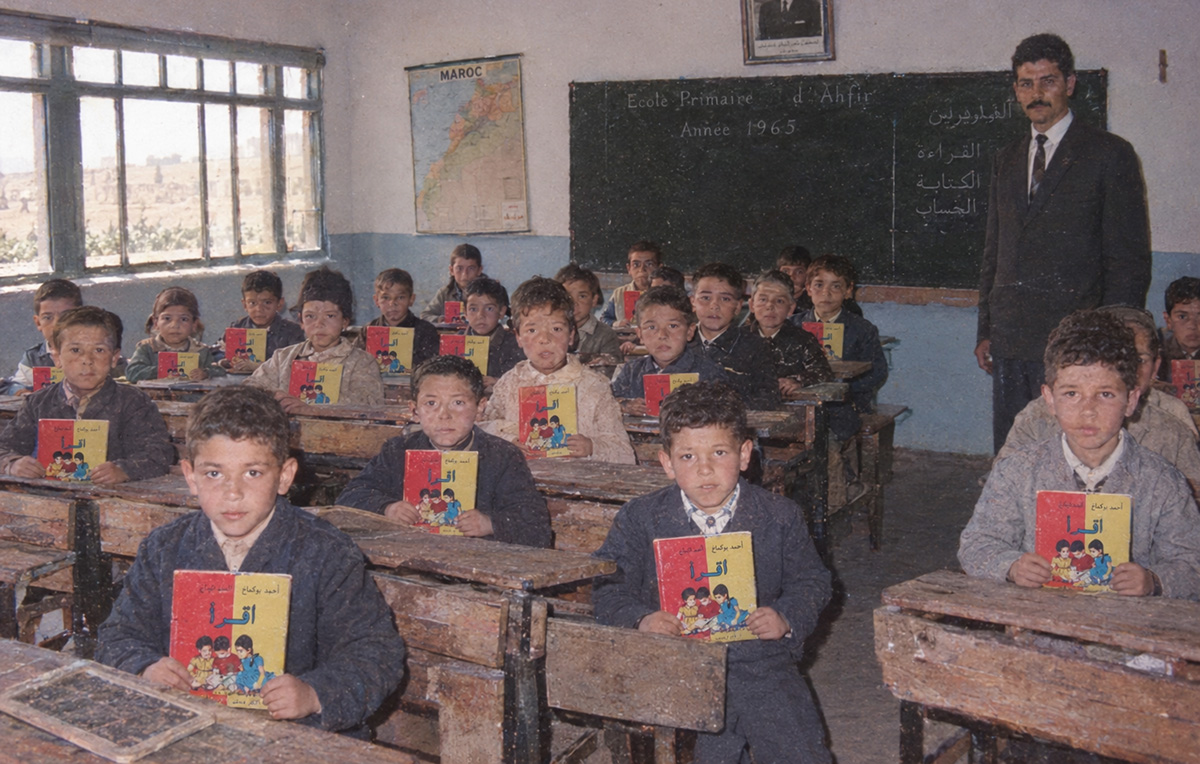
Twenty-six years ago, I was twenty-six years old. It was then that my mission as a teacher in Ahfir came to an end after spending six years at its middle school. Officially, I remained part of the education system, but in reality, I believe my true teaching career ended at that point. Afterward, I never felt that I was contributing even a drop of water to the ocean of education. It was not because I was not working. There was hard work, exhaustion, and thousands of kilometers of travel between Rabat, Marrakech, Laayoune, and Oujda, yet with almost no real impact. It became little more than attendance, taking absences, and students writing without enthusiasm, motivation, or meaningful learning. It was quite different from my years in Ahfir, which were marked by great enthusiasm and solid educational achievement.
I taught around 1,000 students from Ahfir. Most of them are now civil servants or professionals, and many have become doctors and academics.
I never met any former student who complained about my laziness or unfairness, except for one woman who commented on my previous article. She claimed that she had been hardworking and deserving of first place, but because she lacked beauty and did not come from a wealthy family, I had pushed her down to second place. This, she says, is proof that my injustice never exceeded a difference of one rank!
I write this for two reasons: first, to praise myself in preparation for elections, and second, to compare education today with education a quarter of a century ago.
At that time, the official school year began on October 1, but actual classes did not start until November 1. The school year ended before May. School holidays could last up to fifteen days, and preparations and celebrations for the Throne Day festivities would take nearly a month. Despite the limited number of school days, there was a sense of blessing in that time, and students achieved far better results than they do today, without the need for extra tutoring.
So what happened between yesterday and today?
Personally, I believe the change is not in teachers or students, but in the curricula and teaching methods. They have changed so much that parents can no longer help their children with their studies. As for me, I am not convinced by educational approaches that start from the whole and move to the parts, or from the paragraph to the sentence, then the word, and finally the letter. I remain convinced that learning should progress from the simple to the complex, from the easy to the difficult, from the letter to the word and then to the sentence.
Latifa Laâbida, Secretary of State for Education, stated that the curricula and teaching methods were good and free of problems. According to her, the problem lies inside the classroom. In other words, the curricula are sound, but teachers do not know how to implement them.
Personally, I agree with her. However, Latifa, if you know that we do not know how to apply your methods, why do you insist on sending them to us? Better ordinary curricula that we can implement than excellent curricula that remain unapplied.
She also stated:
“We call for the creation of associations to support the School of Success initiative, in order to mobilize community support for schools and promote project-based work to overcome difficulties, develop educational action, and improve the quality of educational services. The Ministry, at the central, regional, provincial, and local levels, is working to support educational teams. It is also necessary to respect educational time and review our educational practices.”
End of quotation.
And honestly, if anyone understands what all of that means, please explain it to me!
It is a shame for those responsible for education. Boukmakh taught them, helped them reach important positions and generous benefits, and in the end they criticize him… or rather, they criticize the educational methods he left behind.
By Jelloul
2009