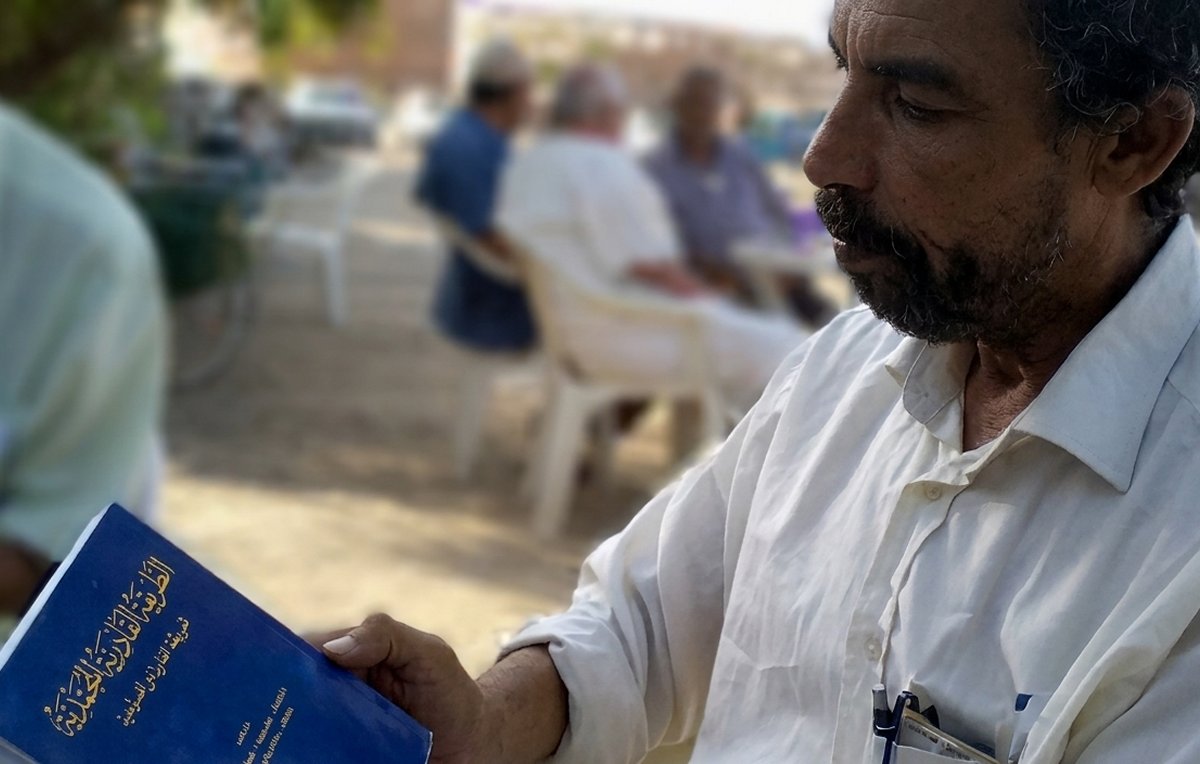
A book entitled The Muhammadan Qadiriyya Path has been published by its author, Mokhtar Ben Ali, the current sheikh of the zawiya.
Published by Tarifa Printing House, the book consists of approximately 200 pages. Beyond its historical and scholarly content explaining various Sufi concepts and terms, its significance lies in the fact that the author relied exclusively on manuscripts and documents preserved in the zawiya’s archives.
Moreover, the work of Sheikh Mokhtar, who is also a physics teacher, is notably free from the myths, legends, and superstitions often associated with religious lodges and which many rational minds find difficult to accept.
The book is rich in information. It includes a section dedicated to the founder of the order, Sidi Abdul Qadir al-Jilani, his teachings, beliefs, and knowledge. Another section explains Sufi terminology, while a further section discusses the principles of the spiritual path, its stages of progression, and the rules governing relationships between the sheikh and disciple, among disciples themselves, and between disciples and society at large.
Before examining these topics in future articles, I have chosen to dedicate this article to the history of the Ahfir zawiya from its foundation to the present day. I hope Sheikh Mokhtar will forgive me if my summary does not fully do justice to his work. Here is the story.
Around 1550, a man named Mohamed Ben Boudkhil, grandson of Sheikh Abdelrazak, who was himself a descendant of Sidi Abdul Qadir al-Jilani, was living in Ain Sefra, Algeria. Following an Ottoman military campaign, he fled and eventually settled in Sefrou. Later, he returned to his zawiya in Algeria. His son subsequently moved to Taghrabt (Taghjirt) and established a zawiya there in 1635.
The zawiya was subsequently managed by Sidi Mohamed, then Sidi Mokhtar I, and later Sidi Mokhtar II.
Until approximately 1795, these figures may be regarded mainly as preachers, since they had not yet received official authorization within the Qadiriyya order. This changed when the father of Emir Abdelkader arrived from the zawiya of Mascara and granted authorization and spiritual license to Sidi Mokhtar II. Thus, in 1823, Sidi Mokhtar II became the first officially recognized sheikh of the Qadiriyya order in the Ahfir region.
At that time, Lalla Mghania, a disciple of the zawiya, was living there. The city of Maghnia would later be named after her.
He was followed by:
Sheikh Sidi Mohieddine in 1852;
Sheikh Mokhtar the Mujahid in 1893.
The latter earned the title “Mujahid” because he proclaimed jihad against French colonial rule. Deeply involved in agriculture, he owned thirty-six plows and introduced a variety of turnip that still bears his name today: the “Sidi Mokhtar Turnip.”
He was arrested in 1907, fined 1,500 francs by the Maghnia court, and exiled to Madagh, where he founded a new zawiya among the Houara tribe west of the Trifa region.
He was succeeded by Sheikh El Mekki in 1914, who expanded the zawiya and organized its educational activities.
After him came Sheikh Sidi Mostafa, under whose leadership the Ahfir zawiya known today was founded, following events marked by tensions resembling a leadership dispute.
Sheikh Sidi Mostafa became head of the Madagh zawiya in 1936. After falling ill in 1944, he was hospitalized. According to the account, a doctor warned him of a plot intended to prevent him from leaving the hospital alive. He returned to the zawiya, only to discover that its affairs were being managed according to a different approach by Sheikh Sidi Boumediene Ben Lemnour.
As a result, he left Madagh and established a new zawiya in Ahfir in 1944. He passed away in 1978.
He was succeeded by his son, El Hadj Ali, about whom many people still recount stories of spiritual blessings and extraordinary deeds. He died in 2001.
He was then followed by Sheikh Mokhtar Ben Ali Al-Qadiri Boutchichi, a former teaching colleague and professor of physics.
Written by Jelloul.
04/07/2013