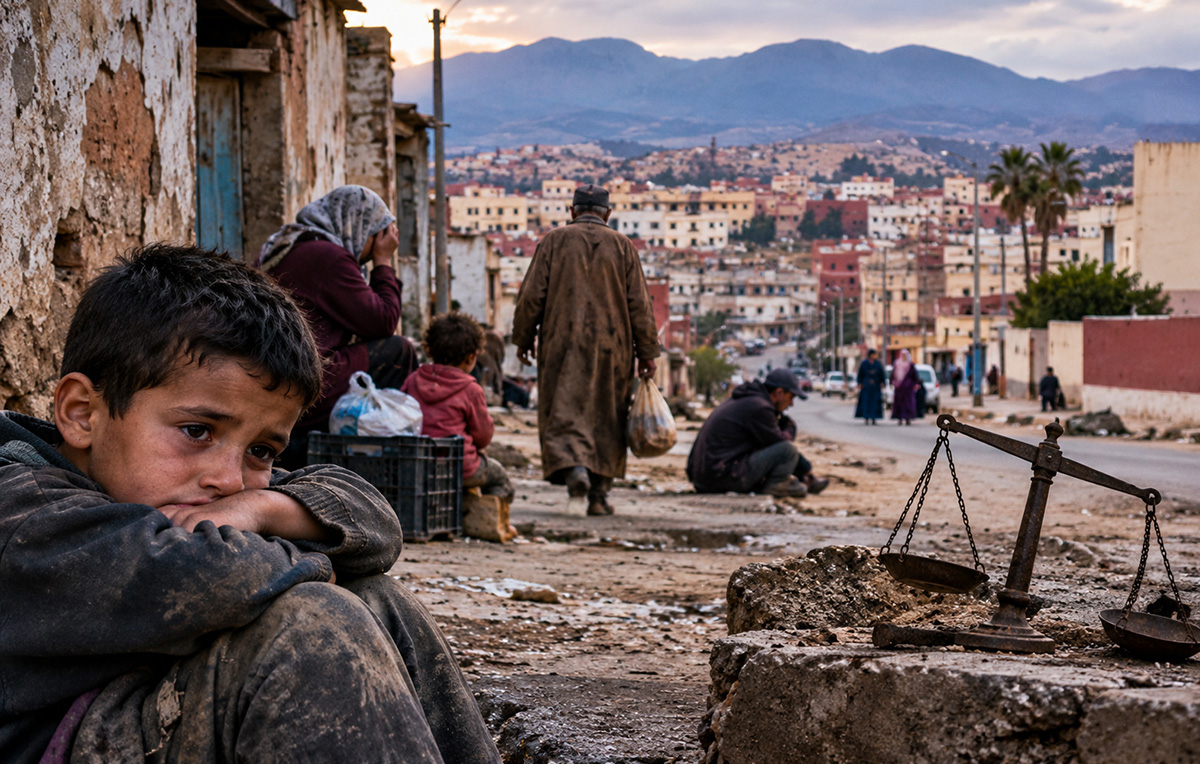
It is clear that only the law can effectively regulate human life. When the rule of law is absent, many people behave without regard for others. In developed Western countries, people generally enjoy a dignified life in which rights are protected. In developing countries such as Morocco, however, people’s rights are often violated on a daily basis.
Many Moroccans live in conditions marked by hardship and humiliation, not only because of state institutions but also at times because of the actions of their fellow citizens. Factory and business owners, for example, may exploit workers to operate machinery without granting them even a small portion of the rights they deserve. As a result, it is common to hear expressions such as: “God bless the countries of the Westerners; here, if people do not kill you, they will not let you live.” Such statements can almost make one believe that Westerners are naturally more compassionate and humane.
In reality, what encourages citizens in democratic countries to respect one another is not innate virtue but the existence of laws that are enforced equally for everyone.
In the neighborhood where I live, there is a villa owned by a French citizen. He employs a young Moroccan man as a caretaker. Anyone who saw where this young man sleeps and how much he earns would question whether that Frenchman truly reflects the ideals often associated with Europe.
The caretaker wakes up at dawn to clean around the villa and water the garden. He does not go to sleep until well after midnight. Meanwhile, the owner and his wife sleep comfortably in their warm bedroom, while the caretaker spends the night in a tiny room in the garden, barely suitable for decent living conditions.
Could this Frenchman treat a caretaker the same way in France? Probably not. There, the law ensures that people receive their rights. This is precisely what Morocco needs if it wishes to achieve genuine and profound change.
People in developed countries were not born with exemplary behavior. Rather, it is law, education, and discipline that have shaped their conduct.
Moroccans living abroad generally respect traffic laws in their host countries. Yet some of them abandon these habits as soon as they return home, disregarding traffic rules and driving recklessly. The reason is simple: enforcement is often less strict. In other countries, penalties are serious enough to discourage such behavior.
When the law is absent, misconduct spreads. This demonstrates that Europeans, Americans, Australians, and Canadians did not become law-abiding by nature but through strong legal systems and consistent enforcement.
Similarly, thousands of Moroccan women who travel to Spain under legal employment contracts to harvest fruits benefit from respectable wages, regulated working hours, and additional protections. Meanwhile, many women working in agricultural farms owned by Spaniards in Morocco receive low wages and work under difficult conditions.
Why does this happen? Because Spain provides stronger legal protections for workers. As a result, women employed there often enjoy better working conditions than those doing similar work in Morocco.
Even in politics, it is the law that encourages public officials in Western democracies to act more responsibly and transparently. Without legal accountability, they would not necessarily be different from their counterparts in authoritarian systems.
The case of former French President Jacques Chirac is a notable example. After leaving office, he faced legal proceedings related to alleged misconduct dating back to his tenure as Mayor of Paris.
In contrast, when some ministers leave office in countries where accountability is weaker, they may retire abroad and enjoy fortunes whose origins are rarely questioned. Meanwhile, individuals accused of corruption may continue to benefit from public resources without facing consequences.
In short, human beings require laws and accountability. Without fair and effective enforcement of the law, society cannot function properly.
By Mohamed Raji – 2009