I believe that success in life requires fulfilling the five pillars, plus three additional achievements: raising children, writing a book, and planting a tree.
Personally, apart from the five pillars, I think I have accomplished all three. I have three children (or five, depending on whom you ask), I have written three books, and I have planted three trees: one in Aghbal with the Al Qalaa Association, one on family land, and one in Karbous at the end of the 1960s.
While the fall of a few trees has recently caused considerable public debate, the growth of entire forests took place in complete silence. I would like to take this opportunity to pay tribute to the late El Haj Chater, our khalifa during the 1970s, who deserves credit not only for planting trees around the military barracks and the Youth Center, but also for creating the Karbous forest when the area was still completely barren.
When we were students in middle school, trucks used to take us to Karbous to plant trees. El Haj Chater cared not only about trees but also about cleanliness in the streets and even on people’s heads. He sometimes refused to issue administrative documents until a person corrected what he considered an untidy haircut.
I remember one occasion when he passed through our alley in Ghar El Jifa and saw me standing there. He called me over and ordered me to pick up some lemon peels lying in the middle of the road. Feeling offended, I replied, “I wasn’t the one who threw them there.” He immediately slapped me and said, “Pick them up and stop arguing!” I ran home, hid in the bathroom, and cried in private, away from the eyes of those who might mock me.
Those responsible for cutting down trees these days undoubtedly have their reasons. Those protesting against such actions also have legitimate arguments. One thing should be noted, however: if anyone hopes to gain electoral points from this controversy, I doubt it will be of much use, unless the law changes and trees are eventually granted the right to vote.
Opponents of tree cutting start from the idea that God, out of His love for birds, created trees as their natural habitat. Their opponents jokingly reply that the problem was solved long ago with the invention of the cage. Some supporters of tree removal have even asked me to publish the only condition under which they would join the environmentalists: guarantees that their coffee cups will be protected from bird droppings produced by the birds living in the trees lining café terraces.
As for the blessed olive tree, “neither of the East nor of the West,” whose oil improves when water becomes scarce, those accused of destroying it remind us that regulations prohibit planting fruit-bearing trees within the city.
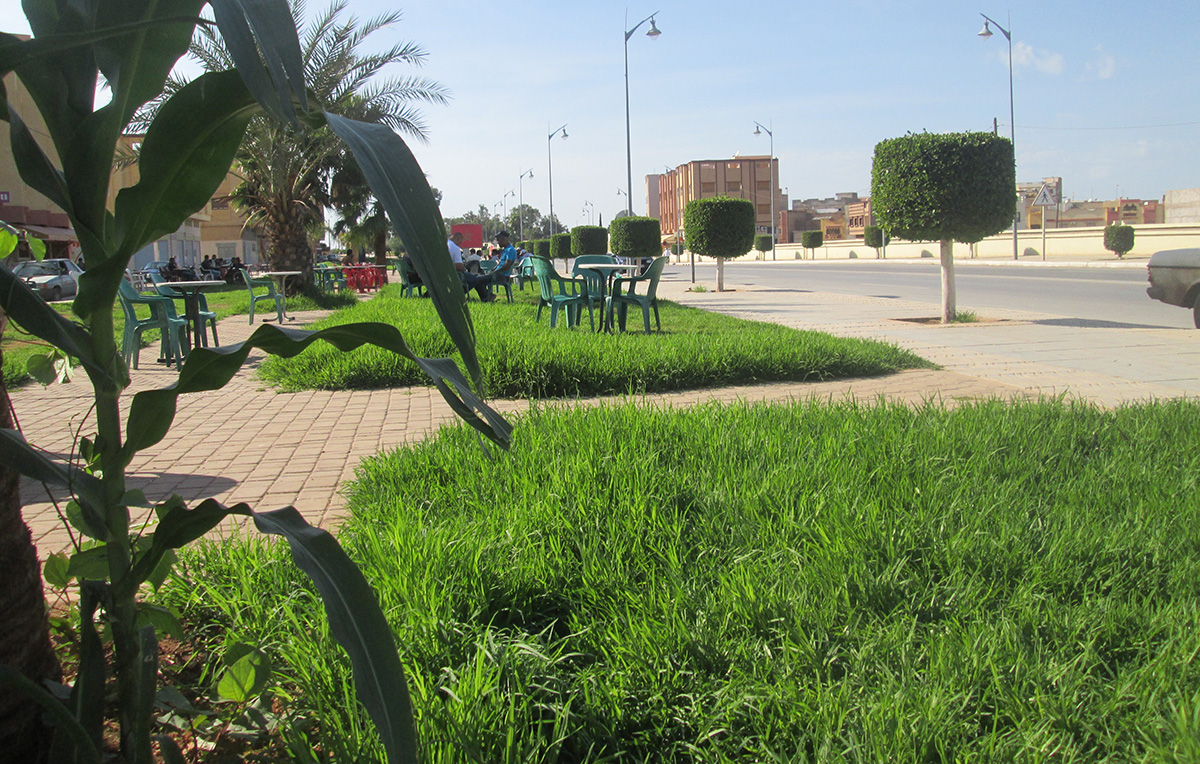
This brings back memories of a time when Mohammed V Avenue was lined with mulberry trees. One day, the son of the post office manager fell from one of them and broke his leg. His father filed a complaint by invoking the relevant regulations. The request was accepted, and the mulberry trees were replaced by the trees that stand there today, although it seems the municipal authorities may now be considering replacing them with palm trees.
The president of the network asked me why I had not publicly expressed my opinion on the current tree controversy. My answer is that issues related to planting, cutting, and replacing trees require us to think not only about trees, water, and soil, but also about the future.
And that, I must admit, is beyond me. Even though Martin Luther is said to have declared, “If I knew that the world would end tomorrow, I would still plant an apple tree today.” But just because someone said something does not mean I have to follow it.
That concludes my thoughts on the controversy surrounding the real tree. Because there is another, symbolic tree that could have caused an even greater uproar had colonial rule not changed some of our laws: the family tree, particularly those of the Sharifian families.
Before the colonial era, anyone who possessed an official genealogy document proving noble descent was exempt from paying taxes. According to a decree issued by Sultan Moulay Abderrahmane in 1845, this privilege applied to families such as Ouled Nhar, Ouled Benazza, Ouled Sidi Youssef, Ouled Mir, Cheqarna, Ouled El Mehdi, Belaâcha, and others.
I would have been among the first to demand the restoration of that law and those privileges if the Lmaqaqra family had appeared on that list. Since it did not, I ultimately thank the colonial authorities for abolishing it.
Amro Jelloul
2010