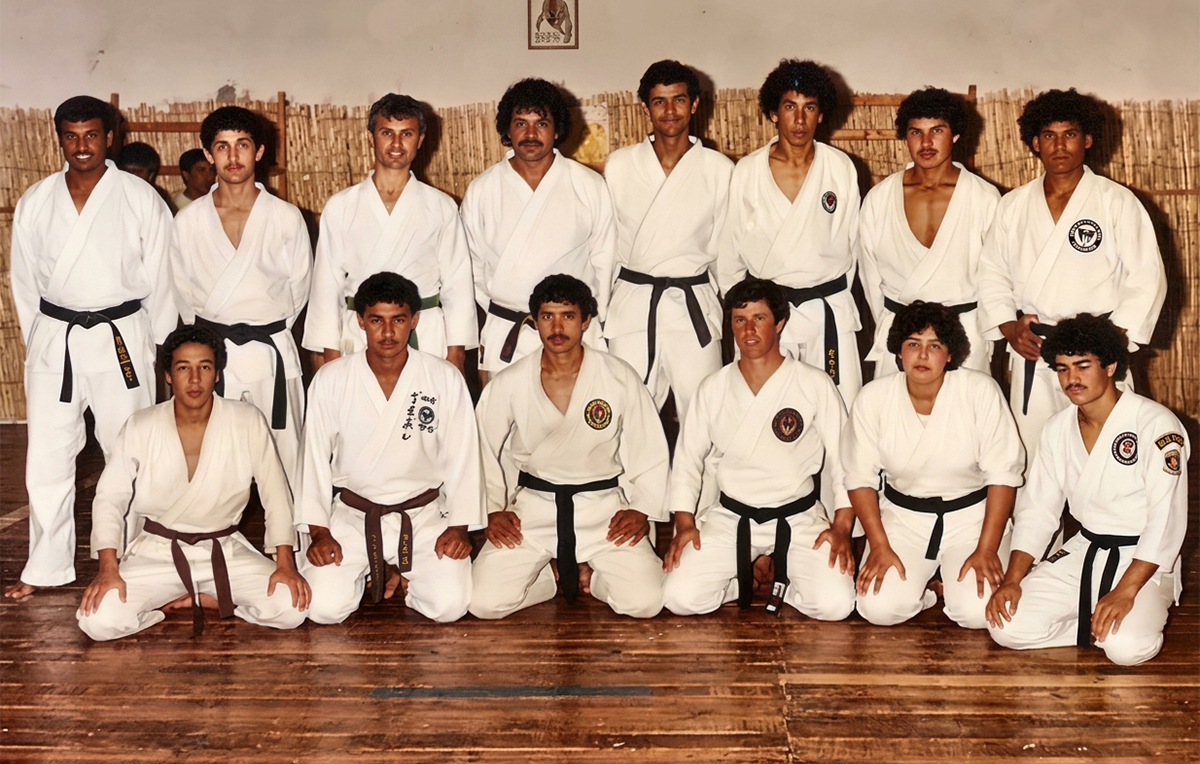
The people of Ahfir remember that the city’s first Wado-Ryu karate club was established in the late 1970s under the supervision of Professor Lakhdar Boumediene. It was also the first karate school of its kind to appear on the national scene. Among its earliest members were Aïssa Lezaar, Mohamed Assal, Kacem Zerrouki, and many others. I only remember these names because I joined them during the years 1982 and 1983. I would be grateful to anyone who has more accurate knowledge of that period and is willing to share it.
The club was initially located near Cinema Maroc, a place that today no longer plays any role in either cinema or theater. If local authorities considered the interests of Ahfir’s youth, the building could be transformed into an indoor sports hall.
At that time, the club was known as the Al-Fath Wado-Ryu Karate Club before becoming the National Wado-Ryu Karate School. This school produced many competent instructors and practitioners despite the social and environmental circumstances of the time. Although financial resources were limited, the passion and love for this martial art filled the hearts of every member and instructor.
One sound united all practitioners: the kiai. It could often be heard from quite a distance. Each student had a unique tone when forcefully expelling air from the lungs and abdomen to produce this famous cry, one of the most recognizable symbols of Japanese karate worldwide.
Beyond its technical purpose, the kiai had a deeper psychological meaning. It expressed the inner aggression naturally present within every human being. By shouting powerfully during evening training sessions, practitioners released this tension and emerged calmer and more peaceful.
One amusing memory concerns some of the older and more experienced students who used to hide certain kata techniques from us and keep them to themselves. They feared that we would learn them and become competitors. They preferred to keep us at a certain level so that we would always remain followers.
I also remember how much we enjoyed taking a shower after training. Each of us brought our toiletries as if we were heading to one of Ahfir’s traditional bathhouses, such as Hammam El Jarda or Hammam Amar.
Among friends, we gave each other nicknames inspired by famous movie stars. I used to call Abdelhafid Radi “Lee Van Cleef,” H’mida Houssini “Jackie Chan,” and Abderrahim Ghanzour “Chuck Norris.” My greetings go to all those old companions.
As for competitions in Oujda, speaking from my own experience, I felt as though I were going to the Battle of Oued El Makhazine. I often spent the night before a competition unable to sleep because of overthinking and stress. This reflected the fact that we had no psychological coaching at that time. Simply participating in a competition was considered an act of courage, regardless of the outcome.
Among the anti-violence principles we learned was how to control our movements without injuring our training partners, a concept known as attack control. However, we remained somewhat distant from practical combat karate used for self-defense in streets and alleyways.
I also remember being required to take part in national celebrations: “The local authority has ordered that you participate in the event.” Officials were always present to give orders but rarely available when support was needed.
Most instructors of the National Wado-Ryu Karate School eventually emigrated abroad in search of a more dignified life. Only a very small number opened their own clubs, such as Aïssa Lezaar. As a result, Wado-Ryu spread only modestly throughout Eastern Morocco due to the lack of support.
Greetings to all former and current members of the National Wado-Ryu Karate School and the Al-Fath Wado-Ryu Karate Club.
Peace be upon you.
The Expressive Cartoonist
H. Dakhissi
2009