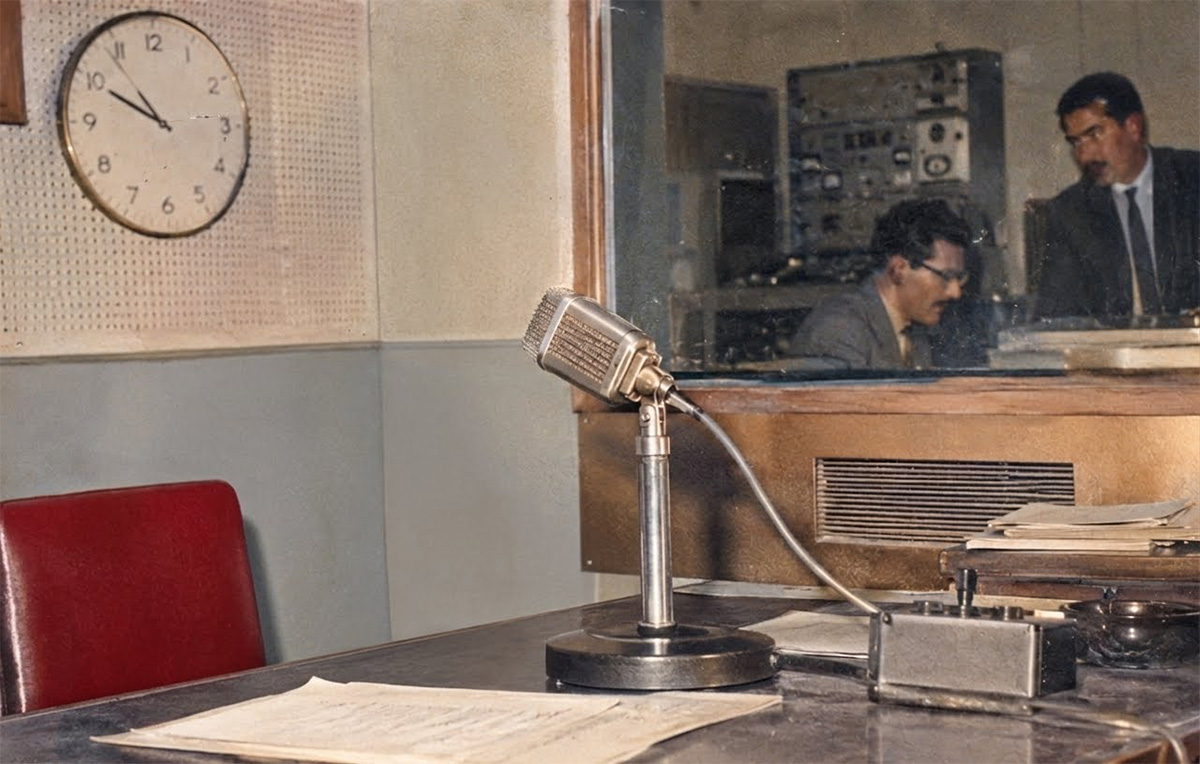
The establishment of the Oujda Regional Radio Station dates back to the 1960s, specifically to 1962. It was considered a major historical event at the time. The station is among Morocco’s oldest regional radio broadcasters, having been created after the radio stations of Tangier and Casablanca.
At that time, the station provided the Eastern Region with a voice, creating a platform for communication, local news broadcasting, and coverage of the various events, activities, and public gatherings taking place across the region.
I remember that in its early years, its daily broadcast time did not exceed three hours. A significant portion of that time was devoted to Moroccan songs through programs known as “Listeners’ Requests” or “What the Listeners Ask For.”
Among its first staff members were Messrs. Al Abed Essoudi Al Qorchi, Kacem Ajdayine, and the late Yahya Al Kourari. Among the technical staff were also two natives of Ahfir, Messrs. El Monour Qadad and Abdelhamid Mimouni, who have most likely reached retirement age by now.
It is worth noting that responsibilities were divided among the station’s personnel. Mr. Al Qorchi was mainly responsible for management, administration, public relations, and major event coverage. Mr. Ajdayine specialized in news presentation, field reports, and sports commentary. The late Mr. Al Kourari handled listener relations and presented several cultural and social programs such as “Echoes,” “Wednesday Magazine,” and “The Journey of Pen and Melody.” He became especially well known through two highly popular human-interest programs: “In the Arms of My Homeland” and “Greetings and Wishes.”
For many years, Radio Oujda enjoyed great popularity among listeners thanks to the quality of its programs in a variety of fields. Several broadcasters and contributors gained widespread recognition and respect.
Among those who helped the station achieve its prestigious reputation were Al Abed Al Qorchi, Kacem Ajdayine, to whom we wish a speedy recovery, the late Yahya Al Kourari and Mohamed Ben Ammara in the field of poetry, Idriss Tiyal in religious programming, Farid Riyahi in language and literature, and Hammad Zarrouki in educational and school broadcasting, along with many others.
I recall an amusing incident that occurred during a cultural quiz program hosted by Al Qorchi. One day in the late 1960s, he invited one of my friends from Abdelmoumen High School. After asking a question about Spain’s most famous bullfighter, my friend Mr. Idrissi could not answer. Al Abed then explained that the man, known as “El Cordobés,” was extremely famous. My friend humorously replied: “If this bullfighter is well known among Spaniards, he is completely unknown among the Idrissis!”
I also remember an episode of the program “Between Secondary Schools,” organized in Berkane during the 1970s between Ahfir Middle School and Ibn Rochd Middle School, under the supervision and presentation of Mr. Mohamed Hammad Zarrouki, a teacher from Oujda. I attended that event and witnessed a remarkable atmosphere of competition, enthusiasm, and activity among the students of both schools. Each team had its own supporters, cheering with applause, chants, and songs.
Where has that spirit of enthusiasm gone? Where is that cultural dynamism and that healthy, fair competition today?
The prominence of regional radio gradually declined due to several factors, the most significant of which was the revolution in communication media and the rapid development of modern information technologies.
Amar Bellahcen
November 3, 2010