When Professor Mohamed M’Barki comforts an expatriate, he comforts him in his own way. He sent me a short story, a kind of condolence to every expatriate. May God reward you, my respected teacher, and may our loss of the homeland be counted for both of us. I wonder: how can an expatriate inside the country console an expatriate outside it, when the pain is the same and shared? May God spare you sorrow after this, Sidi Mohamed.
Mohamed M’Barki – Oujda, Morocco
I was the happiest man alive during that first visit I made that summer. I achieved it after a whole year of severe austerity, reaching the point of deprivation. I denied myself anything new. For clothing, I settled for the archive. I made sure to iron my clothes at the laundry after washing them myself at home. Every day, I polished my only pair of shoes. I cut many unnecessary expenses, but deep inside I feared becoming one of Al-Jahiz’s misers. Barely, after this voluntary hardship, did I manage to gather some money to travel beyond the sea.
When I sat at a table in a square near the Seine in Paris, I breathed a fragrance rising from the depths of the river, a fragrance in which the history of France mingled with the poems of poets and the prose of writers I had read. I breathed freedom with the droplets of water rising from the silent river. I stood up, seized, and rushed toward the river. The café customers thought I was going to throw myself into the water… that I was going to commit suicide. Some prepared to save me. They shouted for me to stop. I stopped, turned to them, and said laughing:
— What’s wrong with you?
An old man said:
— We thought you were going to kill yourself…
I said:
— No… I won’t kill myself. It is my fear that will die. My fear, the heavy fear of the South. The questions crafted in the corridors of police stations in my country will die. Precise questions that created in me an inner censor preventing me from crossing red lines or expressing my opinion. Questions shaped by psychologists, sociologists, specialists in menstruation, shoe shiners, and prostitutes. The answers wrapped in the fear of the nation-state, decorated with images and statues of the leader who once said:
“I am God’s shadow on earth. You are my subjects. I will kill a quarter of you, or half, or three quarters, so that the remaining quarter may live happily.”
We said: “Welcome… welcome…”
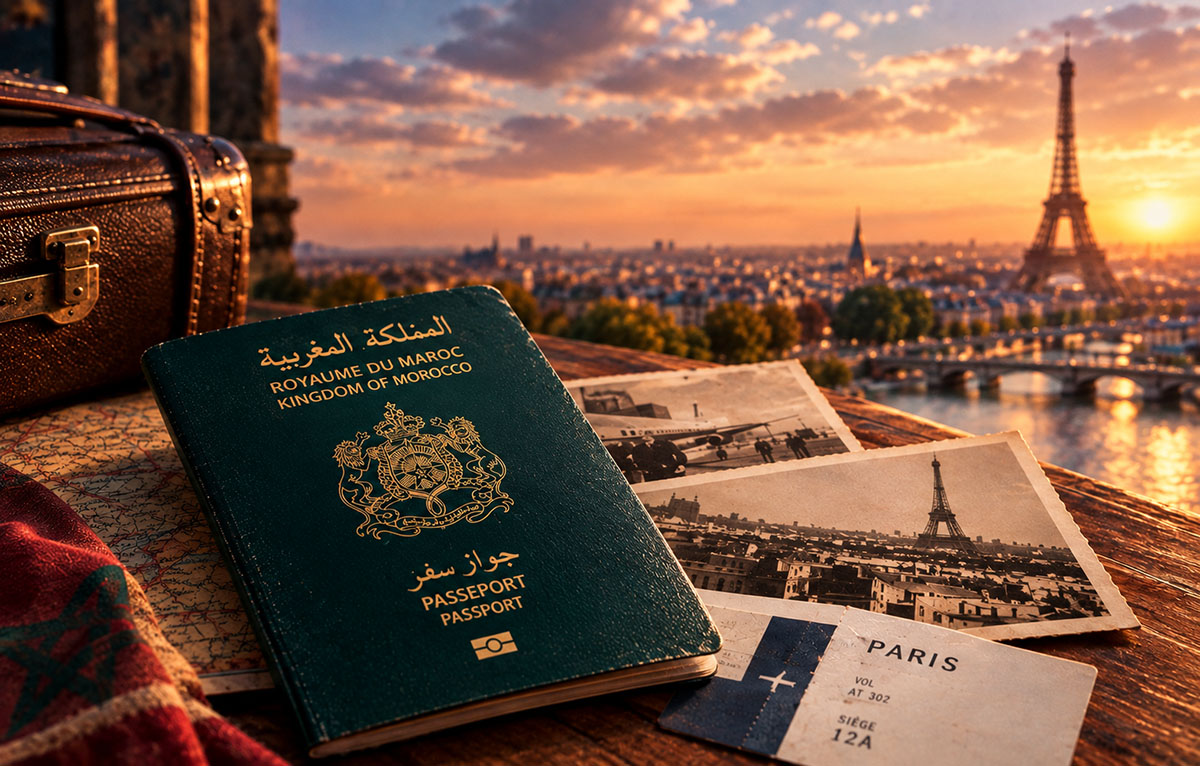
When the passport was a dream, and the employee who issued it was a sultan walking in the streets like a peacock, flattered by the great and the small, by women and men, I was a small employee buried underground, in the archive basement of a public company. I had nothing to do with politics or politicians. Outwardly, at the office, I listened without responding. But inwardly, I was like a pot boiling on a gentle fire, gentle like the company director and the financial officer. We saw him manipulating numbers in fictitious equations from which he emerged victorious while the country lost, in silence and complicity.
I obtained a green passport, green like a mushroom. I left the passport office humming:
“I took the green passport /// and said: here I am, choosing life.”
I laughed heartily and burped like a wild animal full from an imaginary feast.
When they saw me packing my small suitcase to travel beyond the sea, they said:
— Why travel beyond the sea? Your country is long and wide. Travel within it as you wish! Enjoy its riches and its girls; they are like ostrich feathers.
I said:
— I leave the country to you, in all its length and width… I leave it to the one who comes and does not come.
In that red city, I hailed a taxi. The driver slowed down, and I thought he would stop to pick me up. But the dog passed me and picked up two gay tourists, embracing, continuing their love in his car. I spat at him and rushed to a traffic policeman to complain. He scolded me and turned his face toward a beautiful tourist meowing like a cat in heat. I rode a horse carriage. It rocked me gently, and I forgot the incident.
Here I am in Paris, happy with my visit. She opened her arms and embraced me like a child. How wonderful she is, the city of angels and spirits! The spirits fear the angels descending from above, luminous, spreading their light over the city, turning it into an earthly paradise.
“Paris now… Paris tomorrow… Paris forever and always.”
With Lili Boniche, I sang: Paris… Paris…
The idea of the visit turned into something else.
— When will you return to your country?
— Who said I will return?
— Do you intend…?
— Yes, I intend to stay.
— And your job?
— I left it with the country, with the droppings of carriage horses, with the yield of the land, with the sunset in Erfoud, with the sands of the beaches and the desert, with the farms of the plains of Gharb, with the mineral springs, with the beasts of the cedar and juniper forests, with the aïta, the caftan, the “Dmlej Zhor” bracelet, the Saturday night parties, the Mawazine festival, the grass-covered stadiums, the golf courses, Dar Salam, the slums, and the cross-country races toward the looting of public money.
Abdelouahed Mezouirih