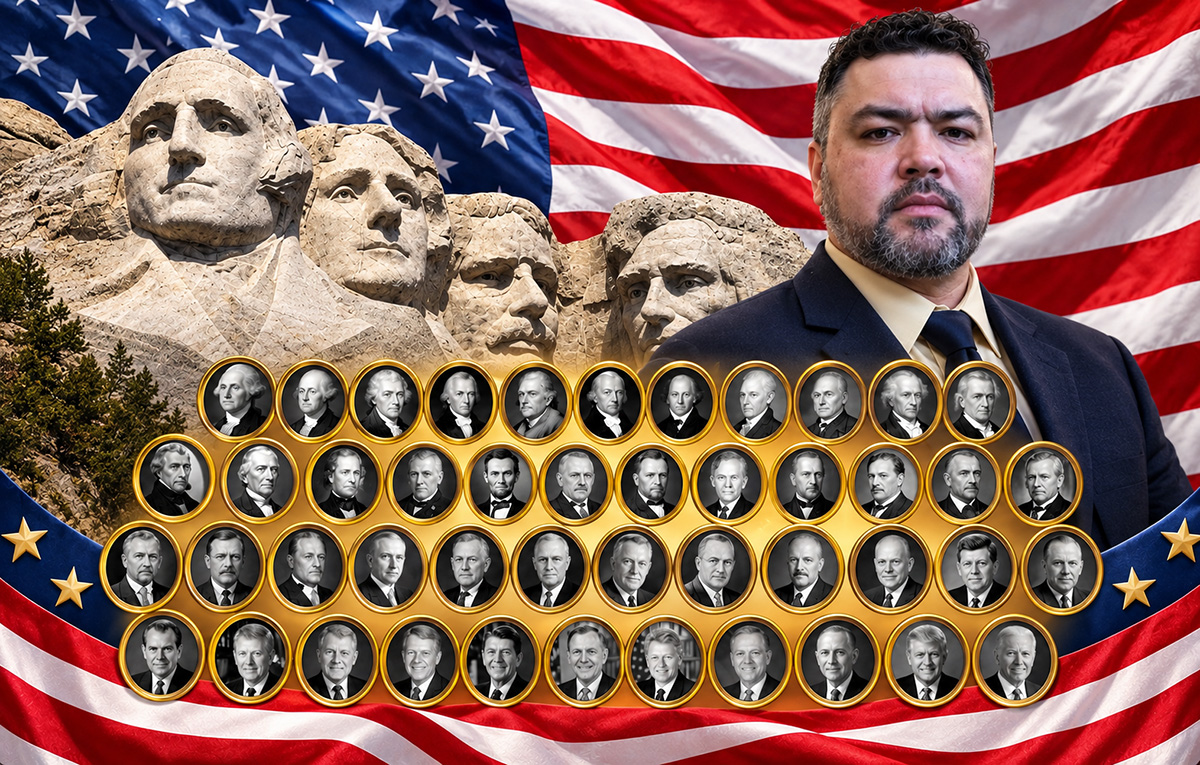
Every year on February 12, the American people celebrate a special holiday known as Presidents’ Day. On this day, government offices close and schools suspend classes. It is a moment when American citizens remember their presidents — their achievements as well as their failures. The plural form of the holiday allows citizens to honor all presidents, from George Washington to Barack Obama.
Any American who reaches the age of sixty remembers having lived under at least seven presidents. They also recall the blessing of alternation and peaceful transfer of power. As they reflect, the American citizen retains an inner free voice, directing it as they wish. They endure a president’s policies for a full term while keeping their vote influential, unmanipulated, and responsive to changes in domestic policy. Their political memory is therefore dynamic and cumulative, reflecting the internal democratic experience of the United States.
As for our poor Arab friend, when he reaches sixty, his memory often retains the image of only one idol — or at best two: one taken by death, and the other toppled by a revolutionary coup, replaced by a third. This image speaks for itself: it is the people who change, while the president remains. The people exhaust themselves to prolong the life of this strange democratic experiment. In a world of transformation and movement, the Arab reality remains frozen. Everything has changed: Eastern Europe, Latin America, Sub-Saharan Africa, even the climate — except our stagnant reality.
Despite some democratic margins — limited freedom of expression, elections, constitutions, political parties — true democracy, the one that ensures real alternation of power, is entirely absent. Existing regimes are not comfortable with the outcomes of genuine democracy, nor with allowing the masses to freely choose their representatives. Yet this is essential for sustainable development and fair distribution of wealth. There can be no development without real democracy.
Some authoritarian regimes may achieve economic progress, but it quickly becomes a private benefit for families that never shared power with the people. How would they share wealth? This growth becomes their property, distributed among their allies: military, security forces, entourage, political parties, and even in-laws. Men of loyalty advance, while men of competence retreat. One’s position depends on their degree of devotion to the idol, allowing them to climb the social ladder rapidly at the expense of millions of competent individuals crushed by poverty and patience.
We must pause and reflect on this mentality that prevails across the Arab world. It has become a conceptual system shared by all. Political parties themselves reproduce the same practices, as if regimes had transmitted this disease to them. How could it be otherwise, when authorities choose their secretaries-general, finance their congresses, and determine their seats? Parties treat their members according to the same criteria: everything is predetermined, and one must simply submit.
Such a reality produces only frustration, despair, political apathy, and even intellectual stagnation. All pathways close before any ambitious person from the people.
How then can we expect a different reality from this political decay? Some political elites attempt to beautify the face of Arab regimes, but these cosmetics disappear with the first popular uprising, as happened in Tunisia. At that moment, conspiracy theories collapse, claims of national interest fade, and the saying “a tyrant is better than civil war” loses its power. The drums of the regime fall silent before the pressure of the people, who face live bullets with bare chests.
It would have been better for Arab regimes to build trust and establish real alternation of power, instead of turning ballot boxes into private property — even idols with their priests and guardians. To prevent our memory from being trapped by a single idol, we must anchor democratic practice within ourselves, our families, our associations, and our close environment. We must believe in democracy before demanding it or practicing its mechanisms.
Culture confronts culture, ideas confront ideas. Especially in an age of abundant information, where forms of gathering no longer require authorization. Even the idol of the charismatic leader has faded. By entering any forum of the youth of the Jasmine Revolution, one clearly sees that the rules of the game have changed: everyone proposes, everyone participates in a virtual parliament more influential than many real parliaments whose members are paid to approve injustice and prolong the tyrant’s rule.
Bahfir