Article 1 | Series: Thinking Differently – A Letter to Safwane and the Youth of Ahfir and Our Beloved Region
My dear Safwane, and to all of you, young people and parents of our beloved town of Ahfir,
Today, I am launching this series of articles with a topic that concerns us all: how to keep a clear head amid the whirlwind of social media, screens, and everyday temptations. Before talking about discipline or rules, I want to share a simple key to help you understand how your own brain works.
1. Dopamine: The Fuel That Drives You to Act
Imagine your body has an invisible fuel that gives you the desire, momentum, and motivation to get things done. That fuel is dopamine. So that everyone understands—from the youngest to the oldest—let’s say dopamine acts like a messenger of motivation in the brain.
It is not the final pleasure itself; rather, it is the drive that pushes you forward because your brain anticipates a reward, a moment of satisfaction, or joy (often linked to what is commonly called the “feel-good” hormone, serotonin). As soon as your brain realizes an action will bring this reward, it releases dopamine to give you the energy to act without getting discouraged too quickly:
• Someone who loves cooking can spend two hours behind the stove with a smile, simply for the joy of sharing a good meal at the end.
• An artist can spend hours, or even days, hunched over a sheet of paper watching their drawing take shape.
If you ever wonder how people keep going for so long without giving up, the answer is this fuel of motivation.
The “Same Burger” Trap
Be careful, though: the brain follows a very specific rule. When you do the exact same thing every day to get the same reward, your body eventually gets used to it and produces less and less dopamine for that activity.
Take the example of a burger you loved at first. The first few times, you find it amazing. But if you order the exact same one over and over again, one day you will say, “Meh, it’s just an ordinary burger.” It’s not necessarily that the burger has changed; it’s that your brain reacts less strongly to repetition.
And that is where the trap closes in: when dopamine drops due to a repetitive habit, the brain demands something stronger to feel the same rush. It will look for a burger loaded with even more sauce, a sweeter cake, a faster or more aggressive video game, or an even more shocking video on social media. That is escalation.
2. Consumption vs. Production: The Two Paths of Dopamine
To understand what is happening around us today—in Ahfir as elsewhere—we need to look at the paths our brain takes to seek out this dopamine. Broadly speaking, there are two routes:
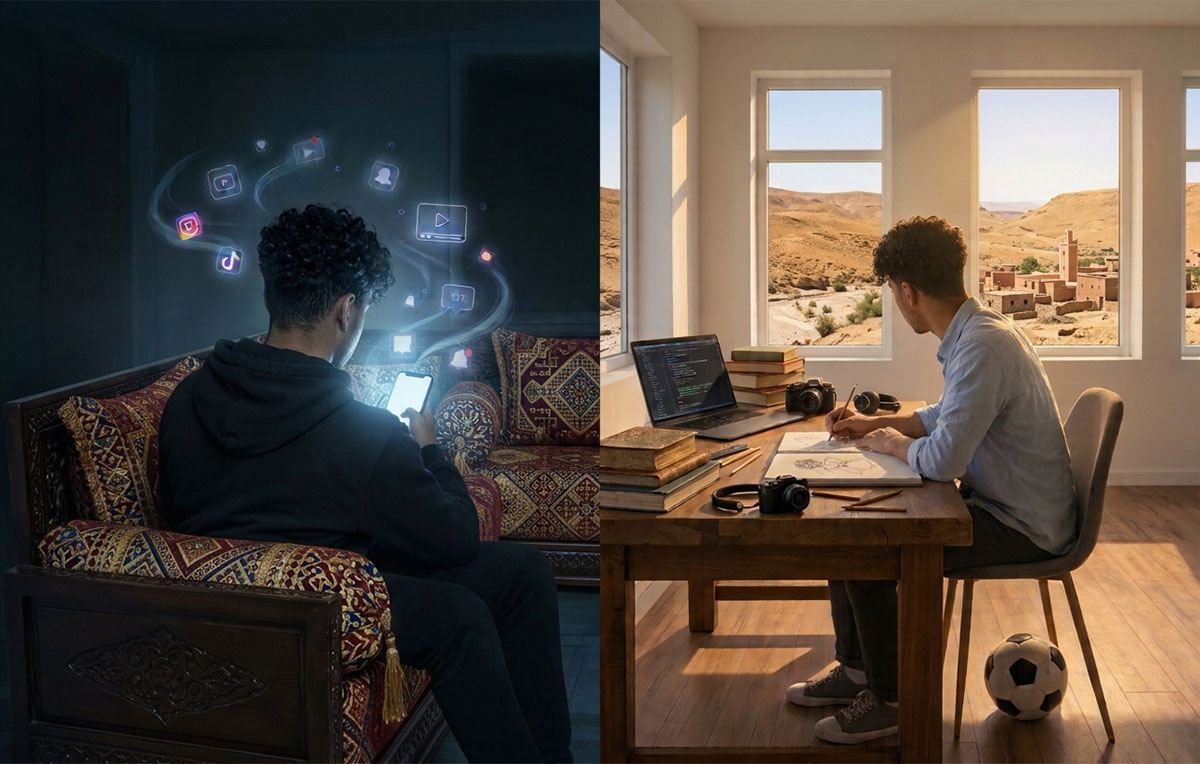
• The path of consumption: This is the easiest and most common route today. Watching a movie, following a football match, playing video games, endlessly scrolling through social media or YouTube, or traveling as a passive spectator. You receive, you watch, you consume.
• The path of production: Drawing, playing sports, writing, self-directed learning, DIY crafting, coding, designing a project, or creating useful content. Here, you build something using your time and energy.
3. The Big Difference Between Addiction and Passion
This is where everything is decided, Safwane:
• When you go all-in on consumption, you quickly slide toward addiction. You need your daily fix of screens, videos, or distractions just to feel okay—and the more you consume, the more you need to feel satisfied.
• When you go all-in on production, you build a passion. You invest effort, you improve, and you leave a real mark behind you.
Let’s go back to our story about dropping dopamine levels. When the brain adapts and demands more:
• On the path of consumption, it pushes toward excess: more sugar, more scrolling, more violence or noise, until it empties your mind and wastes your precious time.
• On the path of production, it can push you to go further in what you create: training a little harder, learning a new skill, or mastering a craft or an art that elevates you.
A Message for You, and for Our Town
Technology and social media are not enemies in themselves, but they are powerful machines designed to press the fast-consumption button. If you let others decide where your attention goes every day, you become a mere consumer of their time and their ideas.
To you, my son: our community needs lively minds, builders, creators, athletes, curious students, and people capable of generating good around them. Don’t settle for watching life scroll by on a screen—become an active creator of your own path.
This was our first step together on ahfir.com. In the next article, we will look at how to manage our time.