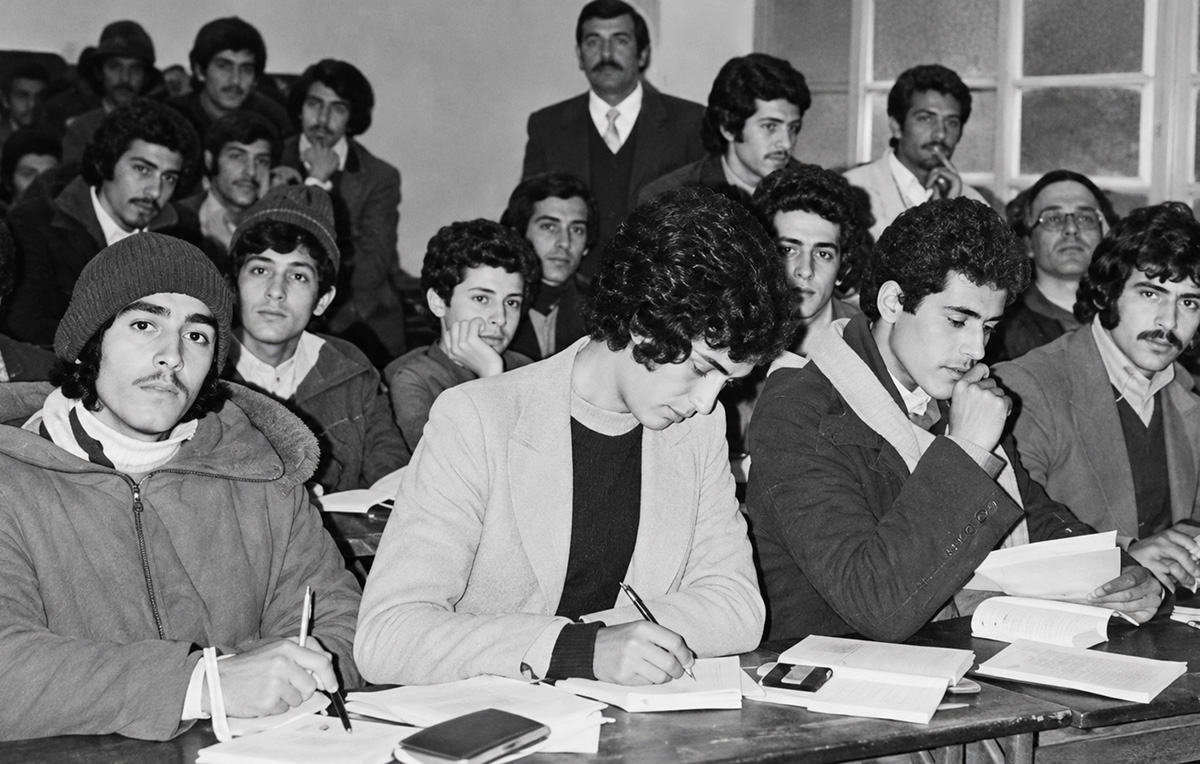
Idriss El Mahdi’s comment on my previous article left me deep in thought and forced me to revisit a contradiction I had fallen into. In that article, I stated that the youth of the seventies were readers and intellectually cultivated. In his response, Idriss asked for proof of this claim by pointing to the books, achievements, or contributions of that generation, or of the “Tatar hordes” said to have invaded and burned the knowledge of our own Baghdad.
I will go even further and say that the youth of the seventies were more active than those of the 2000s. They did not merely consume sports; they practiced them. There was hardly a neighborhood without its own respected local football team: the Sanadiqa team led by the Leksir brothers, the Lbam team led by the Taha brothers, the Dry Garden team led by the Oulhaj brothers, the Hospital team led by the Merzouki brothers, the Oued team led by the Hajari brothers, as well as teams such as Ajax Elir, Laayra, Jnoun Ghar Jifa, and many others. The rise of Bruce Lee and the return of Lakhdar Boumediene also fueled widespread enthusiasm for karate.
There is another thing that may be hard to believe: people rented buses not only to follow football teams but also to support theater groups during amateur competitions. Many members of local associations were familiar with Sartre’s existentialism, Stanislavski’s absurdism, and Brecht’s alienation effect.
The youth of the seventies did not merely listen to music; they performed it. Many played the flute, oud, banjo, violin, and accordion. Every neighborhood had its own orchestra: Essalam, Al Atlal, The Shining Star, Al Bichara, Lmraiya, Al Maâtoub, Al Ansar, Oued, and others.
At that time, most people, myself included, believed in the power of culture to bring about change. Today, most people, again including myself, see culture mainly as a way to pass the time.
The youth of the seventies were not necessarily scholars, but they were educated and culturally aware. My philosophy is that science saves society, while culture mainly benefits the individual who possesses it. Their level of culture was not exceptionally high, but it was sufficient to take advantage of the opportunities available. They benefited greatly from a favorable environment and strong state support. Student grants were guaranteed, and someone enrolled in six institutions could receive six scholarships.
(I personally received two scholarships in addition to an education allowance.) Overseas scholarships were easy to obtain. There was even deliberate leniency in many areas, including certain forms of misconduct, with the objective of building an educated middle class capable of leading society forward. Unfortunately, things did not turn out that way.
This generation eventually occupied important positions, including roles involving major decision-making responsibilities. Yet it became accustomed to taking without giving much in return. Even recruitment examinations offered compensation simply for participating. We would sit for exams in agriculture, railways, electricity, and phosphate companies, sometimes handing in blank papers because all we really wanted was reimbursement for travel and accommodation.
I personally received compensation to travel to Casablanca for an exam at a sugar factory. I never even went to Casablanca, yet I later received a letter informing me that I had passed.
In conclusion, the state placed great hopes in the youth of the seventies and gave them significant opportunities. However, once they assumed responsibility, many continued to focus on privileges and benefits rather than contributing meaningfully. Those, then, are the “Tatars” that Idriss is looking for.
As for books, we collected 300 books in the Al Amal Association, 1,500 books in the Association of Former Students of Ahfir, and 3,000 books during the Time of the Book event. Where are they now? Why even look for them? People no longer read.

By Jelloul – 2010