Countries around the world are rich in popular sayings and proverbs that reflect a heritage of wisdom passed down from generation to generation.
Likewise, the city of Ahfir is full of expressions and sayings drawn from our folk heritage. Although this heritage is shared across a vast region, Ahfir maintains its own unique character.
Before many villagers moved to the city, most lived in rural areas in houses built of stone, with roofs made of wood and reeds, a construction method that is still used by some people today.
At that time, the traditional mason worked with very simple tools: a trowel, a float, and a few basic implements. He would build walls about fifty centimeters thick, using large stones in some places and smaller ones in others. Special corner stones, known as “qantia”, were placed at the edges of the structure.
Construction was always completed with the roofing stage. Rural houses shared a similar design. They often included an isolated room called “M’jeyra”, reserved for guests. Whenever a visitor or distant relative arrived, they were welcomed directly into this room. In some villages around Debdou, I even observed that this guest room was connected to the main house only through a small opening through which meals were passed.
Not so long ago, a villager came to Ahfir looking for a skilled mason capable of rebuilding such traditional walls. Since very few were still practicing, he was directed to one of the city’s craftsmen. After agreeing on a price, the mason accepted the job.
The next morning, the mason arrived to repair the back wall of the house. Unable to find the usual volcanic stones required for this type of construction, he decided to use another kind of stone. He brought a quantity of smooth river stones from the wadi. Naturally, these stones were unsuitable for this type of work, especially since he intended to use traditional “ghiss” mortar instead of cement.
He began to build, placing one stone upon another. Soon, however, he noticed that the wall was starting to lean. Worried that the owner might discover the problem, he hurried to finish the job.
After completing the work, he gathered his tools and called the homeowner to request payment.
The owner replied:
“Let’s meet tomorrow at the market. I don’t have any money with me right now. I’ll sell some wool and pay you then.”
The mason looked at the bulging wall and answered:
“Give me the wool instead, and I’ll sell it myself to cover my expenses.”
The homeowner agreed. The mason took the wool, mounted his bicycle, and hurried away.
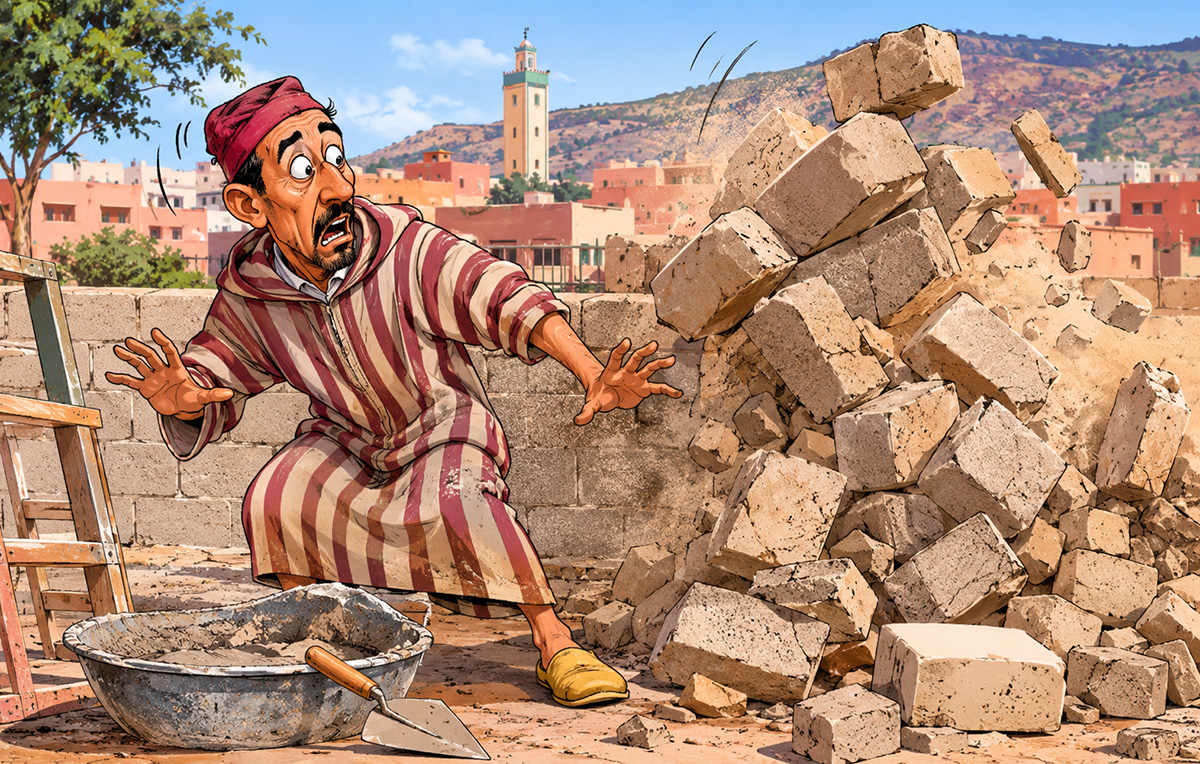
Barely had he reached the paved road when the wall came crashing down.
The owner started shouting:
“Hey, Si Flane! Hey, Si Flane!”
But the mason pretended not to hear and continued on his way.
The following day, they met again at the market. The mason had already sold the wool and finished his shopping.
The owner said:
“My friend, I called you for a long time yesterday, but you didn’t hear me.”
The mason replied:
“Everything is fine, isn’t it?”
The owner answered:
“The wall you built for me collapsed.”
Pretending to be shocked, the mason asked:
“Really? It completely fell down?”
Then he continued:
“Where did you get the water you used?”
The owner replied:
“From the washing basin.”
Immediately finding an excuse, the mason said:
“That’s the problem! The water contained soap. That’s why the wall collapsed. You should have used water from the spring or the well!”
Since hearing this story, I have fully understood the meaning of the popular saying:
“The mason of Maghnia: what he builds in the morning collapses by evening.”
By Yassine Mezzaga – 2012