In the name of God, with whose name nothing in heaven or on earth can cause harm, the All-Hearing, the All-Knowing.
Peace, mercy, and blessings of God be upon you.
My brother Mustapha, I hope you are well, that your family is doing well, and that your students are doing well too. Take good care of them in your school. Treat them kindly, for they are like a lasting charity. If you do good to them, they will always remember you with gratitude and pray for you just as they pray for their parents.
Through these reflections, I see that despite all the criticism it receives, the world of education still contains a hopeful and essential element: the relationship between teacher and student. I firmly believe that education is, above all, a matter of human relations and conduct, just as the saying goes: “Religion is good conduct.”
Why do I say this?
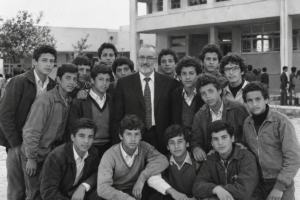
Because while reading your text, I was reminded of some teachers from the old days. Some were influenced by the colonial educational model, recognizable by their gray smocks, while others were enthusiastic practitioners of corporal punishment. These methods had been inherited from traditional Quranic schools and carried over into the post-independence educational system.
Very few teachers were truly kind. Sadly, the majority had little to do with genuine education. They were, in every sense of the word, tormentors. Students would flee whenever they saw one of them walking down a street, in the marketplace, or near a football field.
Even worse, many seemed to specialize in different forms of punishment.
Imagine students being so terrified that they carefully watched what clothes a teacher was wearing that day!
If only the man in red could explain why he became unusually harsh whenever he wore his red outfit, as though he came to school to punish rather than to teach.
If only the teacher famous for his phrase about “one hundred suppositories and one witness” could explain the reasons behind such tyranny.
And what about the specialists of the belt, or those who used table legs as instruments of punishment?
Or the owner of the famous olive-wood stick, and the story of the poor student from the countryside who was forced to bring the very stick with which he would later be beaten, merely because the teacher wanted to test it?
And what should we think of the debates among teachers over whether an olive branch or a pomegranate branch produced the most painful punishment? They argued over which was more effective, despite both leaving painful marks.
Now let me tell you about the master of effortless punishment.
Other forms of punishment required physical exertion: restraining a student, sometimes tying him up if he was strong, and then beating him. The process itself could be exhausting, especially since the child would instinctively try to avoid the blows. This would only make the angry teacher more frustrated, yelling and striking until he saw the student surrender in tears and pain.
If this was not a psychological problem, what was it?
But our “specialist” devised a punishment that required almost no effort.
His preferred tool was a metal ruler, which he would insert between a student’s fingers and squeeze, or strike across the back of the hands.
The strangest thing was that parents often approved of these punishments. They effectively gave teachers a blank check, summarized in a popular saying meaning: “You slaughter him, and I will skin him.”
Some people may argue that without those teachers, neither I nor an entire generation born in the early years of independence would have received a proper education. They point to the academic standards and discipline of former generations as evidence.
My answer is that the issue is far more complicated and that circumstances were very different.
Personally, although I was rarely beaten, I lived in constant anxiety. Fear overwhelmed me every morning. I remember hardly ever eating breakfast during my primary-school years because of stomach pain caused by stress.
For many years I have tried to understand the reasons behind such violence. I searched for excuses for those educators but found none. Most belonged to the middle class, were relatively young, and had obtained stable employment at an early age. Many had a decent educational background, except for a few who came solely from traditional religious schooling.
Could the root cause have been inadequate pedagogical training?
I believe that answering that question would require a serious field study of that generation of teachers, or those who remain alive today. Such a study should combine psychological and educational approaches and also take into account former students, parents, and the educational policies of the era.
What I have written here is a personal testimony. Some may agree with me, while others may find my account exaggerated. Nevertheless, it reflects real experiences that I lived through and suffered from. Some of the psychological scars they left behind took decades to heal.
In closing, I wish to make it clear that I harbor neither hatred nor resentment toward the teachers who taught me. I am grateful for the knowledge they gave me. However, I do criticize the violent and often unnecessary disciplinary methods they used.
Still, we should not forget that many of them played a major role in the failure and discouragement of countless students. Admittedly, this was the result of an educational system as a whole. Yet when you ask the victim, he is more likely to say, “I cannot forgive that teacher,” than “I cannot forgive the educational institution.”
May God keep you under His protection.
Peace, mercy, and blessings of God be upon you.
Abdelhakim Tasirart
Paris, 2009