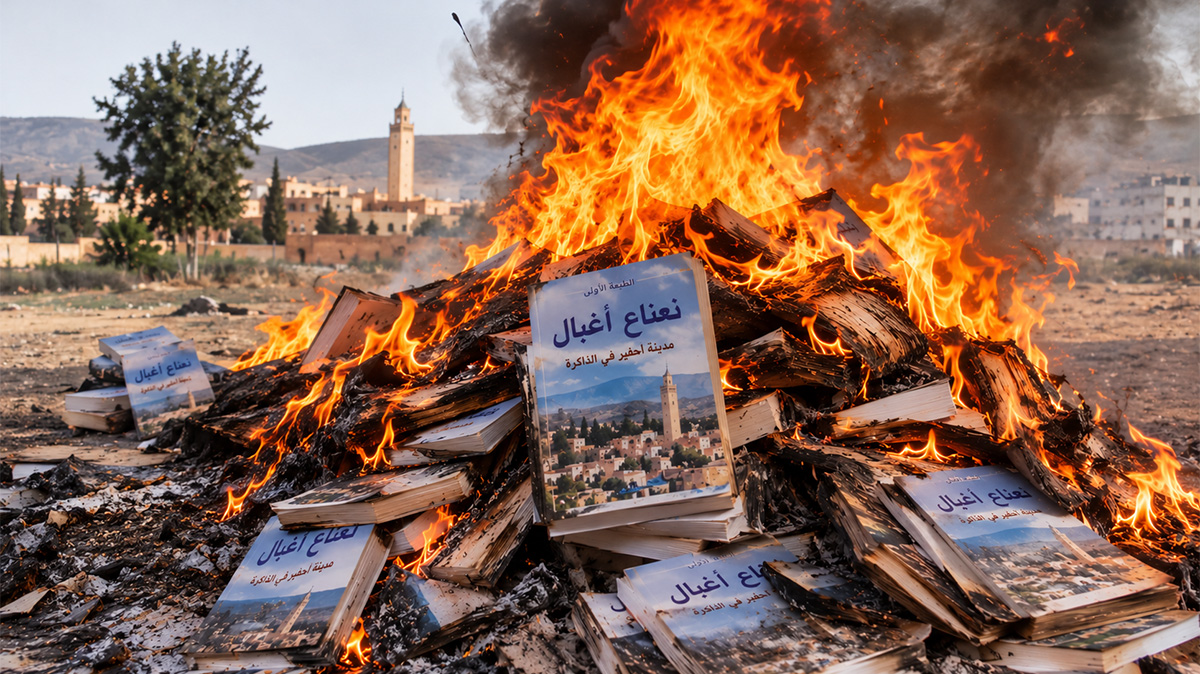
This is not a metaphorical fire. It is a real one: books being burned.
To explain the subject, I will borrow the structure of a traditional school essay, with an introduction, a body, and a conclusion.
First, I would like to apologize for my absence. The reason was simple: the budget previously allocated to Internet access and the cybercafé was redirected to buying potatoes. This is only a temporary situation, no different from previous periods when the website was shut down and later reopened after circumstances improved.
Those situations were often the result of poor management, for which I always accepted personal responsibility. Aware of my own limitations, I have generally avoided taking on collective responsibilities, whether within associations or politics, preferring to leave such roles to those more skilled in administration and management.
When it comes to business, I have played three matches… and lost all three.
The first experience took place in Laayoune. I bought 1,000 packs of Marlboro cigarettes at 10 dirhams each, hoping their price would rise to 15 dirhams, allowing me to make a profit of 5,000 dirhams. Instead, the price dropped, and I ended up smoking the entire stock myself.
The second experience occurred in Marrakech. I transported 1,000 kilograms of Algerian powdered milk from Ahfir. Unfortunately, the very first package I sold turned out to be spoiled. Fearing that other packages might also be defective, and concerned about potential complaints because the goods had been smuggled, I stopped selling them altogether. As a result, I consumed large quantities of milk, yogurt, and dairy products myself.
The third experience took place in Ahfir. After publishing my first French-language book about Ahfir, which was motivated more by passion than profit, I decided to try my luck with publishing in Arabic. I printed 1,000 books: 500 copies of the novel Mouqatilat and 500 copies of the short-story collection Naanaa Aghbal.
Only about 200 copies were sold. Four hundred remained stored in a printing house in Oujda, and another four hundred were left in a printing house in Berkane. Eventually, the owner of the Oujda printing house could no longer keep them and destroyed the remaining copies. The owner in Berkane may soon do the same in order to free up storage space.
The purpose of this article is not to blame the printing houses or anyone else. I did not blame the people of Laayoune for not buying my cigarettes, nor the people of Marrakech for not buying my powdered milk. Likewise, it would be foolish to blame anyone for not purchasing my books.
What I do blame myself for is my inability to convince two successive municipal councils to buy even a single copy for the town library. I also regret failing to persuade more than thirteen teachers, out of roughly five hundred in Ahfir, to purchase a copy.
Nevertheless, I thank God because this failure will not be entirely meaningless. I am convinced that it will bring joy to many people.
Nowadays, it often seems that we celebrate failure more than success. The success of others is sometimes seen as a challenge to our own legitimacy or abilities. Some people rejoice when Ahfir’s football team loses. Others are pleased when the municipality’s finances deteriorate. Some even seem happy to see the town itself decline.
Fail as much as you can… There is a reward in your failure, because it brings happiness and satisfaction to many hearts.
By Jelloul
2009